
Why Is My Shower Leaking? 5 Causes, and How to Tell Which One You Have
A leaking shower is rarely leaking where you think it is.
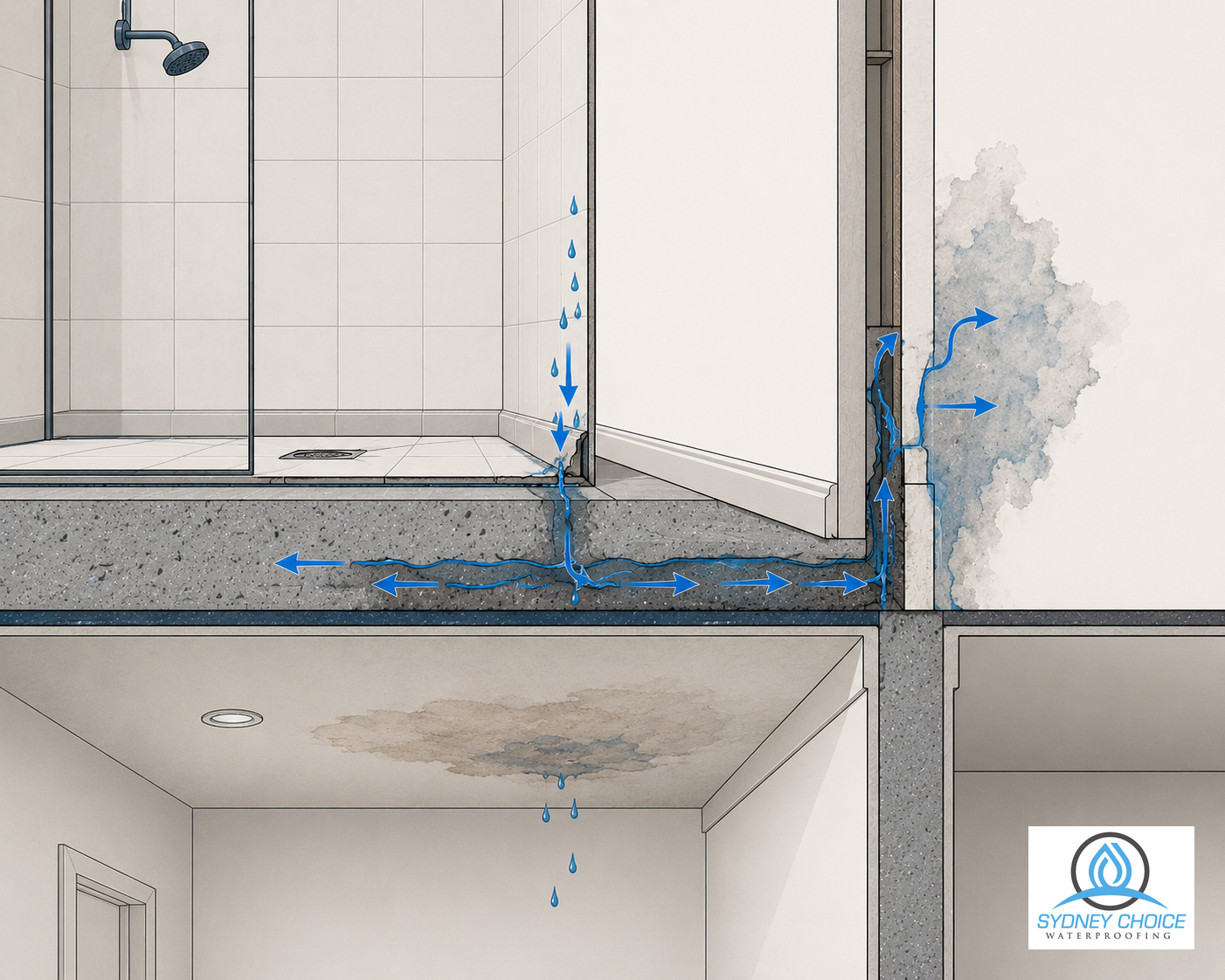
Water runs. It gets through a gap, travels along the underside of a slab or down inside a wall cavity, and appears somewhere else entirely. That’s why so many shower repairs don’t work – the obvious spot gets sealed, and the actual defect is left alone.
Here’s what’s usually behind it, roughly in order of how often we find each one.
1. The waterproofing membrane has failed at a junction
Membranes almost never fail across the middle of a floor. They fail where two surfaces meet – the floor-to-wall corner, the hob, the step down into the shower – and around anything that penetrates them, like the waste.
Those junctions move. A building expands and contracts, and if the membrane wasn’t detailed with bond breakers and reinforcing at those points, it eventually splits.
This is the expensive one, because getting to the membrane means the tiles come up.
2. The waste connection was never sealed properly
The floor waste is a hole cut through your waterproofing. It has to be sealed to the membrane, properly, with the right collar. When that’s rushed, water runs straight past the membrane and into the substrate.
Good news: it’s often repairable without stripping the whole floor.
3. The shower screen seal
Silicone around the base and edges of a screen perishes. It shrinks, lifts, and lets water run behind the frame instead of into the shower.
This is the cheapest possible cause and worth ruling out before anything else. If your screen silicone is cracked, discoloured or peeling away, that alone can produce a damp patch in the next room.
4. Cracked or missing grout
Grout isn’t waterproof and was never meant to be – the membrane underneath is what keeps water out. But badly cracked grout lets far more water reach the substrate than the system was designed for.
If the membrane below is sound, re-grouting helps. If it isn’t, re-grouting is a very temporary fix, and plenty of people spend money on it twice before finding that out.
5. It isn’t the shower at all
Sometimes it’s a plumbing leak – a tap body, a mixer, a pipe in the wall – and no amount of waterproofing will fix that. Sometimes it’s a window above, or a balcony on the other side of the wall.
We’d rather tell you to call a plumber than sell you a bathroom strip-out you didn’t need.
How to tell how bad it is
Rough guide, based on what you can see:
- Damp only during and just after showering, drying out after – often a screen seal or grout issue. Usually the cheaper end.
- Permanently damp patch on the other side of the wall – water is sitting in the substrate. More serious.
- Swollen skirting, lifting floorboards, or staining on a ceiling below – it’s been going on a while and the membrane is the likely culprit.
- Drummy or loose tiles – the substrate underneath is saturated and the adhesive is letting go.
Why acting early actually matters
This isn’t a scare tactic, it’s arithmetic. A screen reseal is a small job. A failed membrane caught early is a bathroom. A failed membrane left for two years is a bathroom plus the floor structure underneath, plus whatever it’s been running into – and in an apartment, plus the unit below’s ceiling.
The problem doesn’t stay the same size while you think about it.
Need someone to look at it?
We inspect before we quote, across Sydney. See our bathroom waterproofing service for how we fix it once we know the cause, or leak detection if you still need to find the source. Call 0450 679 512 or email sam@sydneychoicewaterproofing.com.au.
NSW Contractor Licence 299661C · Fully insured · 7 year warranty